
By Shaina Waterhouse Hiking is such an excellent activity to do with your dog. It…
By Emma Sherril, TLC Education & Outreach Intern
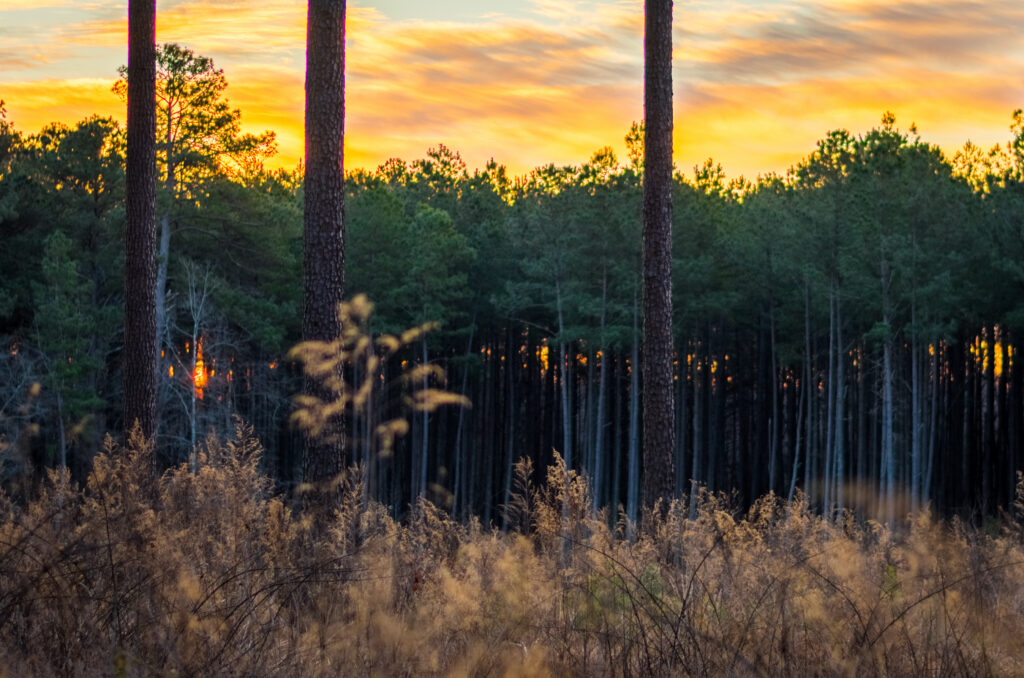
Walk the savanna along the Jordan Trail at Horton Grove Preserve and the canopy reads almost like a timeline. Loblolly pines rise in tall, even ranks, marking decades of planting and past management priorities. Look a little closer, though, an a different pattern emerges. Shortleaf pines appear in the gaps and along the edges, quieter but persistent. Their presence signals not just what this place was, but what it can recover to under active stewardship by Triangle Land Conservancy (TLC).
Across the Piedmont, shortleaf pine historically occupied dry ridges and rocky, south-facing slopes, and occurred in nearly every county in the state. These conditions favored a forest that was open, layered, and structurally diverse. Over time, timber management priorities, agricultural clearing, and the widespread suppression of fire reshaped those systems. Faster-growing species such as loblolly filled disturbed ground, while the absence of regular burning allowed denser midstories to develop. The result is a landscape where shortleaf persists, but rarely dominates, even where conditions would once have favored it.
What makes shortleaf compelling on today's landscape is its relationship to disturbance. This is a species shaped by recurring fire, not harmed by it. Thick bark, the ability to resprout when young, and a tolerance for exposed, competition-free soils allow it to persist where other species falter. In that sense, shortleaf is less a relic than a signal of resilience. Where it grows well, the underlying conditions still support a more open, fire-influenced woodland.
How to identify shortleaf pine in the field
On TLC preserves, identifying shortleaf pine helps visitors see these dynamics firsthand. Mature trees typically have reddish-brown bark broken into large, flat plates, often with small resin pockets visible on close inspection. Needles grow in bundles of two or three and are shorter than those of loblolly, usually only a few inches long. Cones are small and clustered tightly along branches, and they frequently remain attached for multiple seasons.
In mixed stands, shortleaf often appears woven among hardwoods rather than forming dense, uniform patches. Crowns can look slightly more irregular, especially where trees developed in open conditions. These visual cues become easier to spot with practice and offer a way to track where restoration is already influencing forest composition.
Fire as a process, not a disturbance
Fire sits at the center of shortleaf pine ecology. Frequent, low intensity burns historically limited midstory density, exposed mineral soil, created the conditions seedlings need to establish their presence. When those fires disappeared from the landscape, competitive balance shifted, contributing to widespread decline across the species' range.
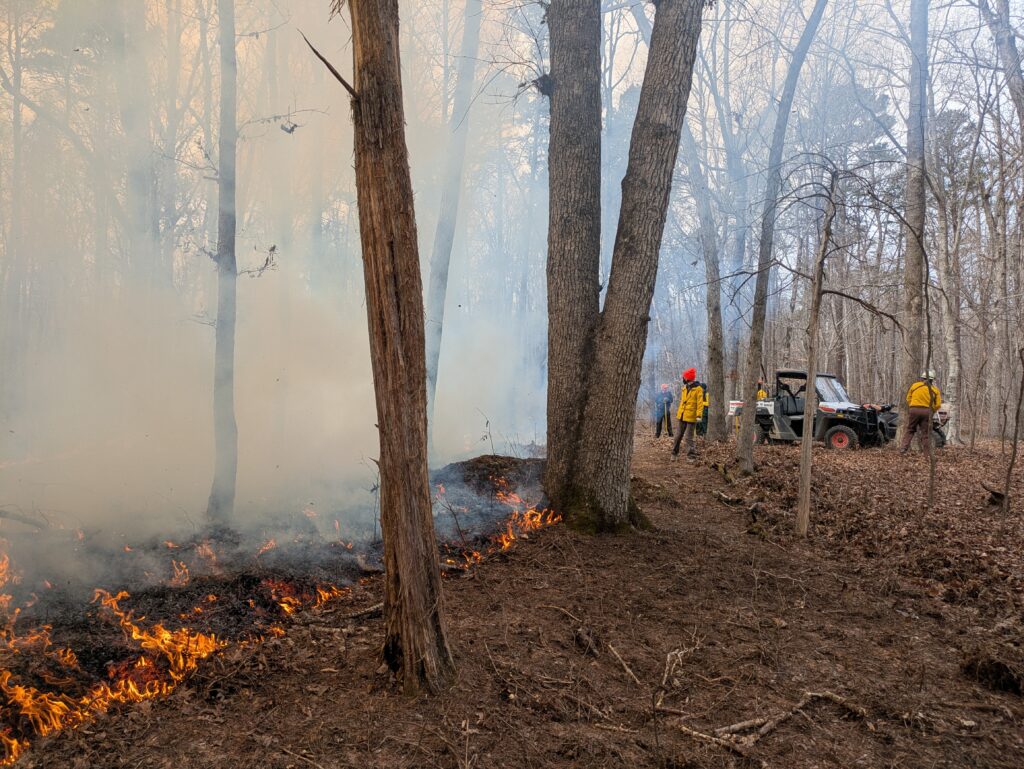
Regional restoration partnerships, including the Shortleaf Pine Initiative, emphasize this process-based approach. The goal is not simply to increase the number of shortleaf trees, but to reestablish the disturbance regimes that allow them, and the broader woodland community to persist over time.
What restoration looks like on the ground
Across TLC properties, shortleaf pine appears in scattered pockets, with some of the strongest representation at Horton Grove. At Brumley Preserve and other sites, management is gradually shifting former loblolly-dominated stands toward more mixed upland systems that include shortleaf alongside oaks and hickories. Strategies vary by location, but they often combine planting, competition management, and planning for future prescribed burns. Some areas are trending toward shortleaf woodland or savanna structure, while others are evolving into mixed shortleaf-oak-hickory communities.
Why the shortleaf pine signals resilience
Shortleaf pine tells a story about continuity. Even after decades of altered disturbance regimes, mature trees persist, holding genetic and structural memory of earlier conditions. Their ability to withstand drought, fire, and variable soil makes them a stabilizing presence as climate variability increases across the region. Where shortleaf expands, it often indicates a system regaining openness, heterogeneity, and ecological flexibility. The shortleaf marks places where the landscape is not just preserved, but actively moving toward a more resilient future shaped by both stewardship and the reintroduction of fire as a natural process.
