
By Margot Lester, TLC Trail Guide and Bluestem Volunteer When you look at a turkey…
By Laura Warman, TLC's Senior Grants Manager
As spring shifts into summer, it’s easy to look outside and think of the usual protagonists: bees and butterflies and the last of the migrating birds, but if you look deeper there's a bunch of other cool critters still waking up and getting to work. Some of these are (arguably) less glamorous, and they don’t have the PR and cheer squad that pollinators do, but they are as fascinating and they play an important role in recycling, making and maintaining soil health, and keeping habitats healthy.
Chances are that you (and/or your kids) have heard of dung beetles- the scarabs that famously roll little (or not so little) balls of dung around. But have you heard about burying beetles? Despite usually being clad in attractive and attention-getting orange or red and black designs, these mostly nocturnal beetles spend their days hiding in the leaf litter or underground and they can be really hard to spot.
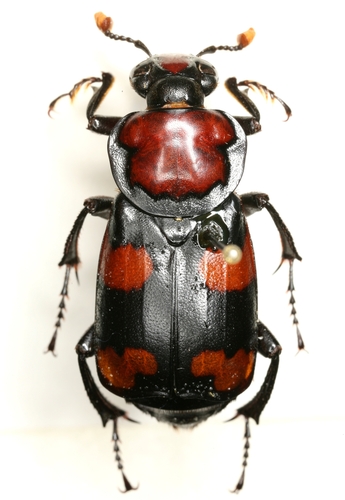
Also called sexton beetles, burying beetles are part of the Silphinae or carrion beetle subfamily. As you might have guessed by now, burying beetles have a knack for burying dead animals, but that is just a part of an astonishing life cycle. One of the most remarkable things about burying beetles is that they are one of very few insects (aside from ants and bees) where the parents tend to their young- rarer still, both parents can be involved. American Burying Beetles (Nicrophorus americanus), also known as giant carrion beetles, are the best-known example of this parental care model, where both the courtship and the larvae-rearing revolve around a small dead animal.
If you take a look at these beetles, you’ll notice their antennae end in large club-like structures. These are hugely sensitive chemoreceptors that allow the beetles to sniff out a carcass as far as two miles away. Once a carcass (usually a small mammal or bird) has been located, the beetles move to it as a couple -unless it’s a single male beetle- in which case he claims the carcass and starts secreting a special pheromone to attract the ladies to his newfound treasure.
Once claimed, the beetles start the hard work of burying the carcass by burrowing under it and slowly covering it with soil. Keep in mind though, that a dead body in the woods is quite the windfall to a lot of creatures, so while they bury, the pair also have to fight off competitors. Aside from mammals, and other insects like ants and other carrion beetles, there’s also many species of flies that are constantly on the lookout for a good place to lay their eggs on. In order to feed their upcoming brood, the burying beetles need to fight off (and sometimes eat) other beetles and insects, keep the meat from rotting, and get it underground as soon as possible. They also have an unlikely ally - burying beetles are often covered in mites that do not feed on them, but on fly eggs. This is a win-win scenario, as the mites use the beetles as transport, and then parasitize the eggs of flies who may have found the body before the beetles did.
The beetle pair work together to trim the hair or feathers off the body, and then roll it into a ball as they bury it- which usually takes about 8 hours. Once buried, the beetles mate and cover the carcass in a series of secretions that have antibiotic and antifungal compounds to keep it bacteria and mold free for their larvae. At this point, the carcass becomes what is known as a “brood ball.”. The female lays eggs in the soil within the underground brood chamber, and about a week later, the larvae emerge and start to feed on the part of the brood ball that the parents have prepared for them. Scientists have documented that the larvae will actually beg their parents for food- much like baby birds! After several days, the larvae bury themselves to pupate, and at least one parent will remain in the chamber to ward off predators and intruders until they emerge.
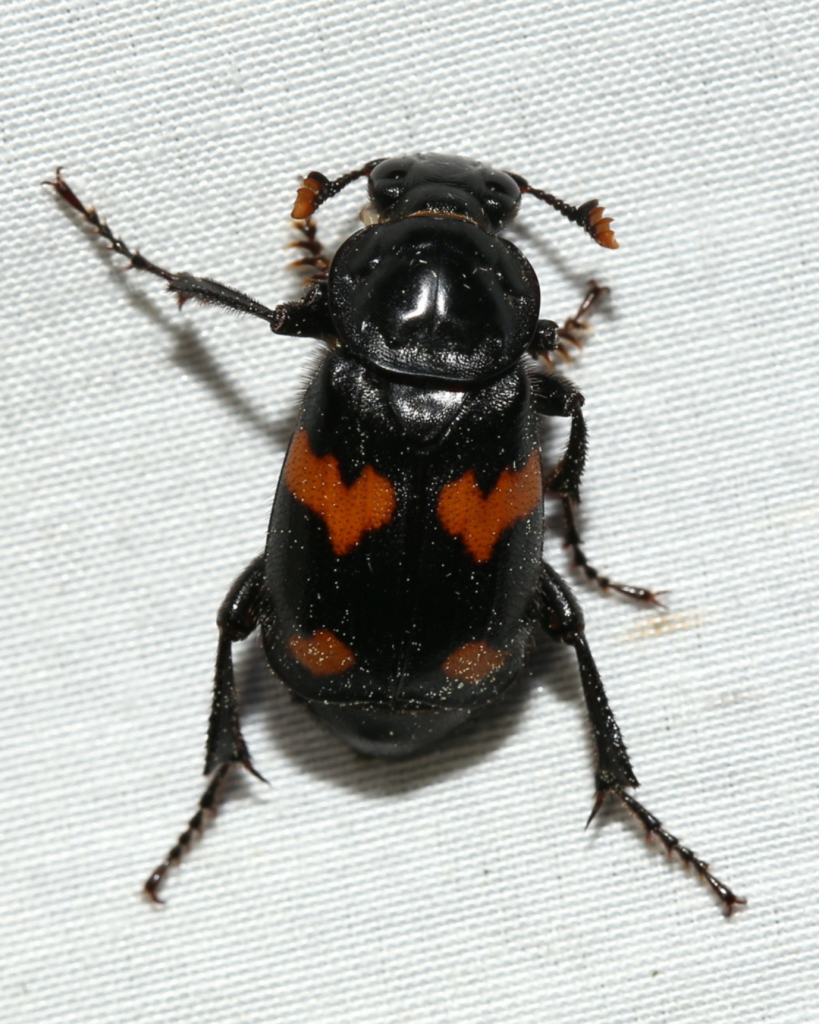
Aside from making for an amazing bit of natural history, carrion eaters like beetles, flies and vultures play a vital role in recycling nutrients and keeping ecosystems healthy. Unfortunately, their roles don’t often get praised as much as they deserve, and in the case of insects, they often go unrecognized. I once even saw the photo of a burying beetle on the side of a pest control truck, despite the fact that they are far from being pests. On the contrary, American Burying Beetles have disappeared from over 90% of their historic range in the US in the last 100 years. They were listed as endangered in 1989, and have since been de-listed but not without controversy, and with limited success in reintroduction efforts. While the American Burying Beetle is native to 35 states, it’s now found in less than 10, and unfortunately, North Carolina is no longer one of them. There are many factors cited in its decline, including habitat loss and increased artificial lighting.
Fortunately, there are still other burying beetles to be found in the Triangle, including the Roundneck Sexton Beetle (Nicrophorus orbicollis), the Tomentose Burying Beetle (Nicrophorus tomentosus) and the Pustulated Carrion Beetle (Nicrophorus pustulatus). Next time you are in the woods, give a thought and a quiet nod of thanks to the cleaning crew that keeps our forests healthy, and if you can, remember to limit how much outside light you have. Then, if you are lucky enough to find a dead mouse, you might just have a ringside seat to a dedicated romance. If you want to come outside at night, also look into the variety of events hosted by TLC including First Fridays under the stars (in collaboration with the Raleigh Astronomy Club) and Moth Nights (in collaboration with Backyard Butterflies).
